


Why Transparent Pay Matters in Tech and AI Jobs (and How to Use It)
Published pay ranges save you from wasted applications and give you a real negotiation anchor. Here is how to read and use them, and what to do when pay is missing.

Founder, NearSkill
On this page
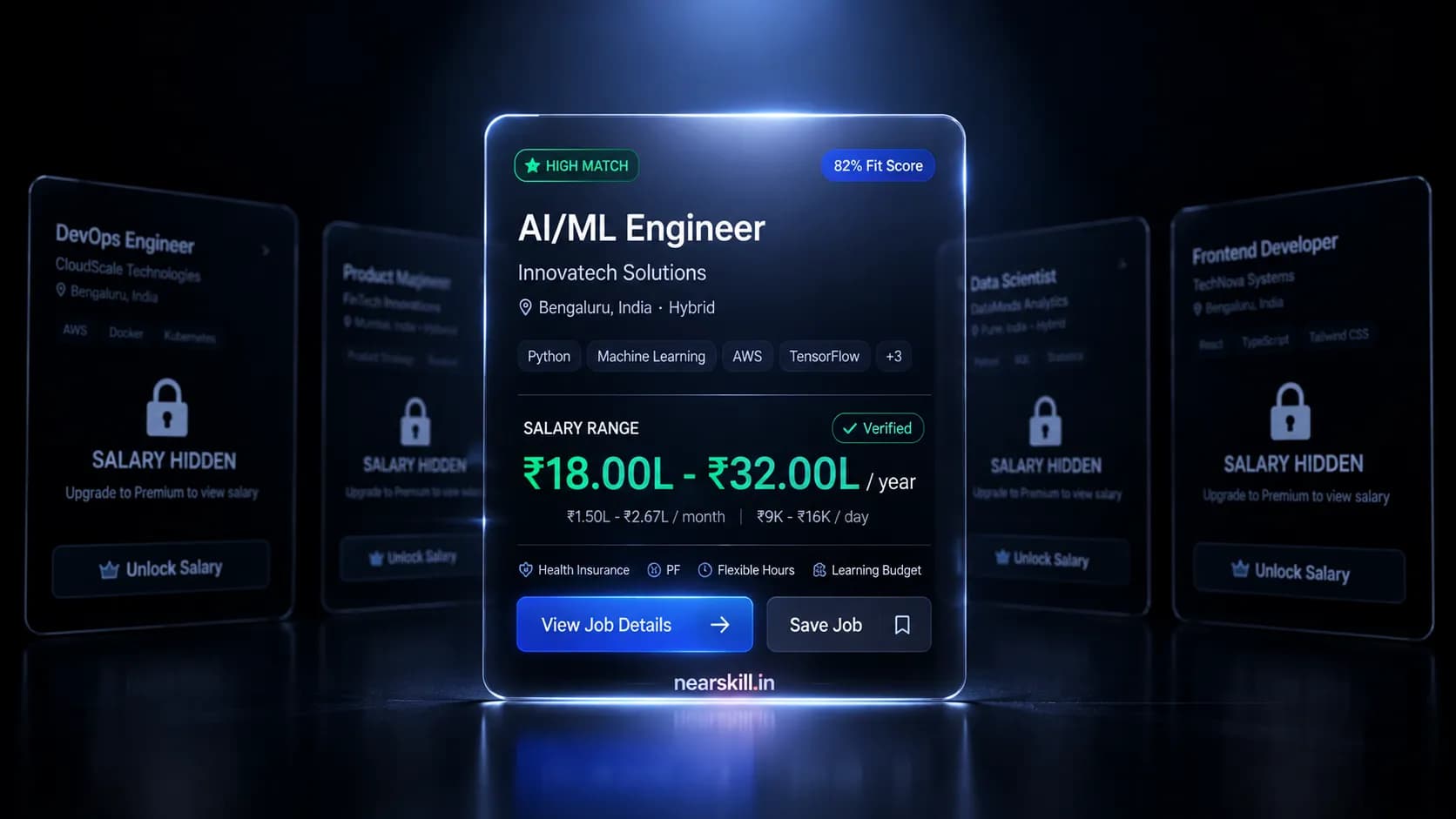
A published pay range is the cheapest, most useful signal in a job posting. It filters roles before you apply, anchors your negotiation, and tells you which employers treat pay as a fact instead of a secret. Hidden pay does the opposite: it wastes your application time, hides below-market offers behind "competitive", and punishes people who negotiate poorly. This guide covers what transparency actually changes, how to read a range like a professional, and what to do when the range is missing.
What hidden pay actually costs you#
Every hour you spend interviewing for a role that pays 40% below your band is an hour you did not spend on a role that could work. Hidden pay does not save anyone time; it just moves the mismatch later in the process, after your resume, your assessment, and three interviews. The mismatch is the same, but you have now invested in it.
- Wasted applications. Job seekers apply to postings without pay data, then drop out when the number arrives. Employers re-open the search. Both sides lose.
- Systematic under-pricing. Candidates who avoid negotiation, historically women and minority groups, absorb the gap when pay is hidden. Published ranges compress that bias.
- False "competitive" offers. "Competitive salary" without a number is a negotiation script, not a compensation statement. It exists to keep your anchor low.
- Mismatched seniority expectations. A range forces the employer to commit to a level. Hidden pay lets the same posting interview staff-level candidates for a senior-level budget.
NearSkill’s position: every role we structure carries its pay fields visibly. When an employer publishes a number, you see the range. When they publish nothing, the field stays visibly empty rather than being filled with a guess. A missing number is information too, and we do not pretend otherwise.
What transparency changes in practice#
| Stage | Without pay data | With published ranges |
|---|---|---|
| Filtering | Apply blind, discover pay late | Filter by band before applying |
| Shortlist | Ranked by title and fit only | Ranked by fit and pay together |
| Negotiation | First number is a guess | Anchor from a real midpoint |
| Outcome | Weeks wasted on mismatches | Mismatches filtered early |
This is why AI Job Match attaches pay to every match card. A 90% skill fit on a role paying half your band is a bad application, and the score should not hide that. The fit score guide explains the boundary: scores measure skill overlap, and pay data covers the rest.
How to read a salary range like a professional#
- Assume the offer lands in the lower two-thirds. The top of the range is the best-case candidate with perfect timing. Plan around the midpoint, not the ceiling.
- Check the range against the market, not against hope. Compare the posting against similar roles with published pay in your category. A range 30% below market is a pricing signal, not a negotiation starting point.
- Use the midpoint as your anchor. State your number first, near the midpoint, and justify it with your evidence: current pay, comparable offers, your skill overlap.
- Let the range do the filtering. If the posted range cannot meet your floor, the application is done. Apply only where the range intersects your real numbers.
The negotiation itself is simpler than most guides make it. You are not asking for a favor; you are moving a number inside a range the employer already committed to. The AI trainer pay guide has current bands by specialty if you need market anchors for AI training and evaluation work.
What to do when pay is missing#
- Ask in writing, early. The first recruiter conversation should include: "Can you share the range for this role?" A direct answer is a green flag.
- Treat "competitive" as a request, not an answer. Reply: "Understood. To make sure we are aligned, what range did you budget for the role?"
- Set your floor before the first interview. Interviewing without a floor is how mismatches survive three rounds.
- Use published-range jobs as your baseline. Match your resume against roles with visible pay, and let their midpoints set your floor for hidden-pay conversations.
One caution: ranges are floors, not ceilings, and some employers publish wide ranges to attract candidates and offer at the bottom. Read the range with your market data, not in isolation. A $60k–$160k range is not generous; it is ambiguous.
The limits of transparency#
Published ranges do not tell you the whole story. Total compensation includes equity, bonuses, and benefits, which rarely appear in the range. A range also does not tell you whether the employer can actually move inside it. Use the range for filtering and anchoring, then ask about total comp before you decide. Transparency is a starting point, not a complete picture.
The legal shift behind the ranges you now see#
Pay transparency is not a courtesy movement; it is regulation in much of the world. California, New York, Colorado, and Washington require pay ranges in postings. The EU Pay Transparency Directive moved toward range disclosure across member states in 2026. Where the law requires a number, the number tends to be honest, because the penalty for a fake range is worse than the penalty for a low one.
The practical effect for job seekers: the missing range is now a choice, not an omission. Employers who still hide pay where the law allows it are signaling how they want to negotiate. Treat that as data. The best employers in tech and AI have moved ahead of the law anyway, publishing ranges because it filters candidates faster and reduces turnover. Browse jobs with published pay and you will see which way each employer leans.
How to ask for the range (scripts that work)#
Asking early and in writing is a skill, not an imposition. Three scripts that work at different stages:
- In the first message: "Before we go further, could you share the salary range for this role? I want to make sure we are aligned."
- After "competitive": "I appreciate that. To keep us aligned, what range did you budget for the position?" The word "budget" reframes the question as logistics, not entitlement.
- After a low first number: "My current role pays at the top of that band. Where in the range can this move, and what changes that?"
The pattern across all three: ask for a system detail, not a personal favor. Employers answer system questions comfortably, and the answer is usually the real range.
Base pay versus total compensation: the full picture#
| Component | Published in range? | Typical size |
|---|---|---|
| Base salary | Yes | The number you see |
| Equity / options | No | 10–50% of base at startups |
| Performance bonus | No | 5–20% of base |
| Benefits (health, leave) | No | 15–30% of base |
| Sign-on / relocation | No | One-time, negotiable |
Use the range for filtering and the total-comp question for deciding. A role 10% below your base with 25% more equity can be the better offer, and you only know by asking the total-comp question in the final round. The contractor guide shows the mirror image of this math for hourly work, where the rate is the total and the benefits are gone.
What counts as transparent, and what does not#
Not every published number is real transparency, and knowing the difference keeps you from over-trusting a wide range:
| What the posting says | What it usually means | How to use it |
|---|---|---|
| $90k–$120k | Real range, likely honest | Anchor at $105k, negotiate up |
| $60k–$160k | Range too wide to be a plan | Ask what the top requires; expect the lower third |
| "Competitive" | No number committed | Ask for the budget range in the first message |
| "Market rate" | Depends on your last pay | Pushes the anchor onto you; refuse and re-anchor |
| No pay line at all | Choice, not oversight | Decide if the role is worth the ask |
The common thread: transparency is a commitment, and wide ranges are the polite form of no commitment. Treat the width of the range as part of the signal, exactly like the width of the skill list in a fit score.
Transparency in contract and gig work#
The same rules apply to hourly contract work, with one twist: the rate is the total, and what is missing is the structure around it. An "up to $100/hr" contract line is the gig-work equivalent of a wide salary range, the ceiling is real, the typical rate is lower, and the hours are not part of the number. For AI evaluation contracts, the transparency question is not just the rate. It is the queue: how many hours can I actually book at that rate this month?
The AI trainer pay guide publishes current bands by specialty, which gives hourly workers the market anchor that ranges give salaried workers. Between the band and the rate line, contract transparency is now computable, and the fit score loop applies to contract queues the same way it applies to salaried roles.
The bottom line#
Transparent pay in tech and AI jobs saves you weeks of wasted process, anchors your negotiation, and filters mismatches before they cost you time. Read ranges with the lower-two-thirds rule, anchor from the midpoint, ask for numbers early when they are missing, and treat published ranges as market data for every hidden-pay conversation.
Next step: browse jobs with published pay ranges, filter by your band, and see your fit score against every role that can actually work for you.
Search jobs with the pay attached
Browse every live tech and AI role with visible pay ranges, filter by your band, and match your resume against the ones that fit. Free, no account.
Written for real AI training and domain expert candidates. No fluff, no recycled job board advice.
Frequently asked questions
Why does pay transparency matter for job seekers?
A published range lets you filter before you apply, price your skills correctly, and negotiate from a real anchor instead of a guess. Hidden pay forces everyone to waste time on applications that cannot work, and it systematically under-prices people who negotiate poorly or not at all.
How should I read a salary range?
Assume the real offer sits in the lower two-thirds of the range, and that the top reflects the best-case candidate. Use the midpoint as your negotiation anchor, justify it with your evidence, and let the employer move toward you or explain the gap.
What do I do when a job posting hides pay?
Ask in the first conversation, in writing, before you invest time in interviews. A clear answer is a green flag. Vague answers like "competitive" without numbers usually mean below-market. You can also match your skills against jobs with published ranges and use those as your baseline.
Does salary transparency narrow the range or widen it?
It narrows the range for the employer and widens it for you. Employers who publish ranges still negotiate, but the extremes disappear: no more lowball offers to the uninformed, and no more asking 2x the budget. Both sides save weeks of wasted process.

Ankit Kumar
Founder, NearSkill
Ankit Kumar is the founder of NearSkill, an AI-powered career matching engine for specialized tech and AI roles, including generative AI training, domain expert evaluation, data science, and advanced software engineering. He built NearSkill after watching the specialized AI job market fragment into postings with missing pay, inconsistent skill requirements, and no way to compare roles side by side. His guides cover AI trainer and domain expert compensation, resume strategy for evaluation roles, how fit scores work, and the skills that matter in generative AI training work.
Related guides

AI Trainer & Domain Expert Pay in 2026: Real Hourly Rates by Specialty
Generalist AI training pays $20–$30/hr. Specialized domain expert work pays $50–$100+/hr. Here is where the rates sit in 2026 and what actually moves them.

How to Improve Your Fit Score for Specialized Tech and AI Roles
Six concrete moves raise a fit score: exact skill names, a seniority line, quantified bullets, less noise, the right roles, and honest keywords.

How AI Job Matching and Fit Scores Actually Work (and How to Improve Yours)
A fit score is an overlap calculation between your profile and a structured job record. Here is what it measures, what it misses, and how to use it.
Find the roles that actually fit you
Upload your resume and get every live role ranked by fit score, with pay ranges attached. Free, no account, results in seconds.