


How to Improve Your Fit Score for Specialized Tech and AI Roles
Fit scores rise when your resume names skills exactly, shows seniority clearly, and drops noise. Here are the six moves that work, in order of impact.

Founder, NearSkill
On this page
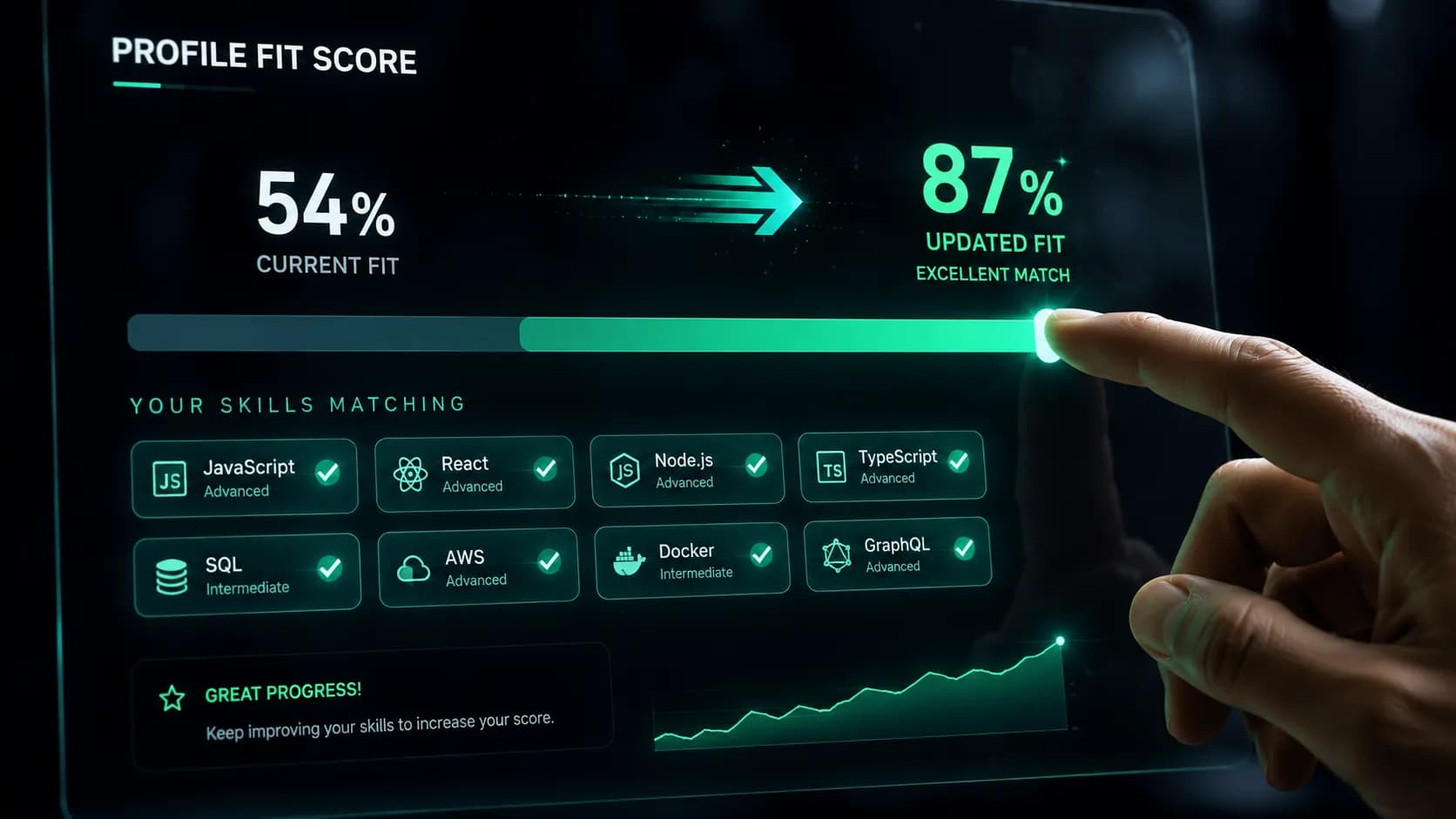
A fit score is the overlap between your parsed resume and a structured job record. That means the fastest way to improve fit score is not "get more experience". It is making the experience you have readable: naming skills the way jobs name them, showing seniority in one clear line, and removing everything that dilutes the signal. These six moves, in order of impact, are what raise fit scores for specialized tech and AI roles.
How the score is computed, in one paragraph#
The matcher parses your resume into skills, seniority, experience years, and industry signals, then compares each against the job record. Required skills weigh most, preferred skills weigh less, and everything else is context. A missing required skill costs more than a dozen matched nice-to-haves. That asymmetry drives every move below. The full pipeline is explained in how AI job matching works.
Move 1: Name skills exactly as the jobs do#
Parsing collapses synonyms, but only the common ones. If the job says "PyTorch" and your resume says "deep learning frameworks", the matcher may never connect them. Pull up the five jobs you want most and copy their exact skill names into your skills section:
- Use the version the market uses: "React", "PyTorch", "Kubernetes", "LangChain", "PostgreSQL".
- Put skills in a dedicated section, not only inside bullet prose.
- Match casing and naming. "LLM fine-tuning" and "Large Language Model fine tuning" may not merge.
Do not paste the job posting into your resume. Name your skills accurately; the matcher reads the overlap. The move is wording, not copying.
Move 2: Show seniority in one unambiguous line#
Seniority signals are the second heaviest input, and they are the most commonly ambiguous. "Lead engineer", "tech lead", and "staff engineer" map to different bands on different engines. Fix it with one line under your name:
"Staff Machine Learning Engineer · 9 years · GenAI evaluation & fine-tuning"
Now the matcher cannot misread your level, and every job record with a staff-level band matches cleanly. If your titles never carried a level, state it directly: "Senior-level contributor in 3 of the last 5 roles".
Move 3: Quantify everything the job asks for#
Matchers weigh skills they can see in context, and quantified bullets give the parser both the skill and the evidence. Two versions of the same bullet:
| Weak for matching | Strong for matching |
|---|---|
| Built evaluation pipelines for LLM outputs | Built LLM evaluation pipelines covering 40k outputs; cut manual review by 35% |
| Worked with vector databases | Designed RAG retrieval on pgvector; p95 latency 210ms over 12M vectors |
| Improved model accuracy | Fine-tuned a 7B model; F1 up 9 points on the internal benchmark |
The strong versions keep the exact skill names ("LLM evaluation", "pgvector", "RAG", "fine-tune") while adding numbers the parser and the recruiter both read. The resume guide applies the same rule to AI training and evaluation roles specifically.
Move 4: Cut the noise that dilutes parsing#
- Drop the skills cloud. Thirty items dilute the ten that matter. Keep 8–12 named, provable skills.
- Cut unrelated history. A 2014 retail job adds zero match signal to a 2026 ML application and distracts the parser.
- Remove unverifiable claims. "Proficient in everything" parses as nothing.
- Delete formatting the parser can trip on. Tables, multi-column layouts, and text boxes scramble field extraction. One column, standard headings.
Parsing quality is the invisible multiplier. A clean one-column resume parses close to perfectly; a designed PDF parses with missing skills. If your score sits far below your expectation, the layout is the first suspect.
Move 5: Target the roles your profile can win#
A fit score is relative to the job record. Two roles in the same category can score 80% and 55% for the same person, because one lists six required skills and the other lists nine. Match for the roles where your overlap is structurally high:
- Sort by score and read the top 10 postings in full.
- Group the next tier by the single skill each one misses. One shared gap explains ten scores.
- Add that one skill with evidence (a project, a certification, a shipped result) and re-match.
- Re-run weekly. Jobs are added and closed continuously, and the top of your list changes.
The same loop works on NearSkill, where AI Job Match re-scores every live role against your profile in under 20 seconds.
Move 6: Keep the honesty boundary#
Keyword stuffing does not survive the interview, and on most platforms it does not even survive the match: unsupported keywords are discounted when the parser finds no supporting context. Worse, employers increasingly probe claims with technical screens. A 90% score built on inflated skills converts worse than a 75% score built on truth. The transparent pay guide makes the same argument for pay: honesty is the strategy that compounds.
The 30-minute score audit#
When a score sits below your expectation, run this audit before touching the resume. It isolates the cause in about 30 minutes:
- Check the parse (5 min). Most match tools show the extracted profile. If skills are missing or garbled, the layout is the problem. Fix formatting first.
- Compare against one job record (10 min). Open your top match and list the required skills. Mark each against your resume. The gap list is your real gap.
- Check seniority (5 min). Does the job ask for a level your resume never states? Add the seniority line.
- Count the noise (10 min). Every skill in your profile that no job in your target list asks for dilutes the signal. Cut the bottom half.
The audit output is a list of one to three concrete fixes, and it tells you which of the six moves will move the score most. Run it once a month, not once, because job records change faster than resumes do.
Parsing pitfalls that silently cost points#
Resume parsers are predictable, and most score gaps come from predictable layout choices:
| Choice | Parser outcome | Fix |
|---|---|---|
| Multi-column layout | Fields scrambled across columns | Single column |
| Skills inside prose only | Missed or partial extraction | Dedicated skills section |
| Icons and glyphs in headings | Section headers misread | Plain text headings |
| Tables for experience | Roles merged or dropped | Standard bullet lists |
| PDF with selectable text | Works | Keep; never scan or image-export |
| Abbreviations without expansion | Split entities | Spell out once, then abbreviate |
The pattern: parsers reward boring, standard resumes. A visually designed resume trades match quality for aesthetics, and for specialized tech roles the match is worth more. If you want the design, keep a machine-readable version for applications and a designed one for humans.
From structuring thousands of specialized AI training and domain-expert roles on NearSkill, these parsing behaviors, drawn from our match pipeline, are the ones that cost the most matches, and they hold for most parser-based match engines. If your platform exposes its parsed profile, check it after every resume change: it is the single fastest way to catch layout issues before they cost you matches.
What to do when the score says no#
A low score is a diagnosis, not a verdict. Three responses in order:
- Check the targeting. Same score everywhere? The profile may be positioned against a market it does not serve. Re-read the fit score explainer and re-target.
- Close the real gap. One missing skill with evidence: a certification, a shipped project, a public write-up. Then re-match and watch the group of affected roles rise together.
- Let the score filter for you. If the profile is honest and the gap is real, the score is doing its job. Apply where the overlap exists and build the missing skill in parallel.
The bottom line#
Fit scores rise fastest when the resume becomes more readable, not more padded: exact skill names, one clear seniority line, quantified bullets, less noise, and better role targeting. Run the loop weekly: match, read the postings, fix the profile, match again. Scores are a ranking tool, and you control most of the inputs.
Next step: upload your resume and see your current scores, then apply these six moves and re-run the match to measure the difference.
Measure your score after these moves
Upload your resume, note your top matches, apply the six moves, and re-match. The score change is visible immediately. Free, no account.
Written for real AI training and domain expert candidates. No fluff, no recycled job board advice.
Frequently asked questions
How quickly can I improve my fit score?
Immediately, if the gap is wording. Renaming skills to match the jobs you want and adding a seniority line raises the score on the next match run. If the gap is real, like a missing core skill, the score only moves after you add that skill with evidence.
Does adding more keywords to my resume raise my fit score?
Only the skills you can prove, and only the ones the job lists. Unsupported keywords lower parsing quality, hurt interviews when the claims are probed, and violate the honesty your profile depends on. Target every job, not every keyword.
Why does my score differ between similar jobs in the same category?
The jobs themselves differ. One posting may list five required skills, another eight. Fewer listed skills means each one weighs more, so a single gap hits harder. Compare the postings side by side before assuming the score is wrong.
Should I apply to jobs below my fit score threshold?
Below 50%, usually not. The role asks for skills or seniority you do not have, and your application competes with people who do. Below 70%, a tailored resume can cross the line. Above 70%, apply early and mention the match in your cover note.

Ankit Kumar
Founder, NearSkill
Ankit Kumar is the founder of NearSkill, an AI-powered career matching engine for specialized tech and AI roles, including generative AI training, domain expert evaluation, data science, and advanced software engineering. He built NearSkill after watching the specialized AI job market fragment into postings with missing pay, inconsistent skill requirements, and no way to compare roles side by side. His guides cover AI trainer and domain expert compensation, resume strategy for evaluation roles, how fit scores work, and the skills that matter in generative AI training work.
Related guides

How AI Job Matching and Fit Scores Actually Work (and How to Improve Yours)
A fit score is an overlap calculation between your profile and a structured job record. Here is what it measures, what it misses, and how to use it.

How to Write a Resume That Works for AI Training and Domain Expert Roles
AI evaluation jobs screen for precision, domain depth, and clear writing. A resume that proves those three beats a longer one that only lists duties.
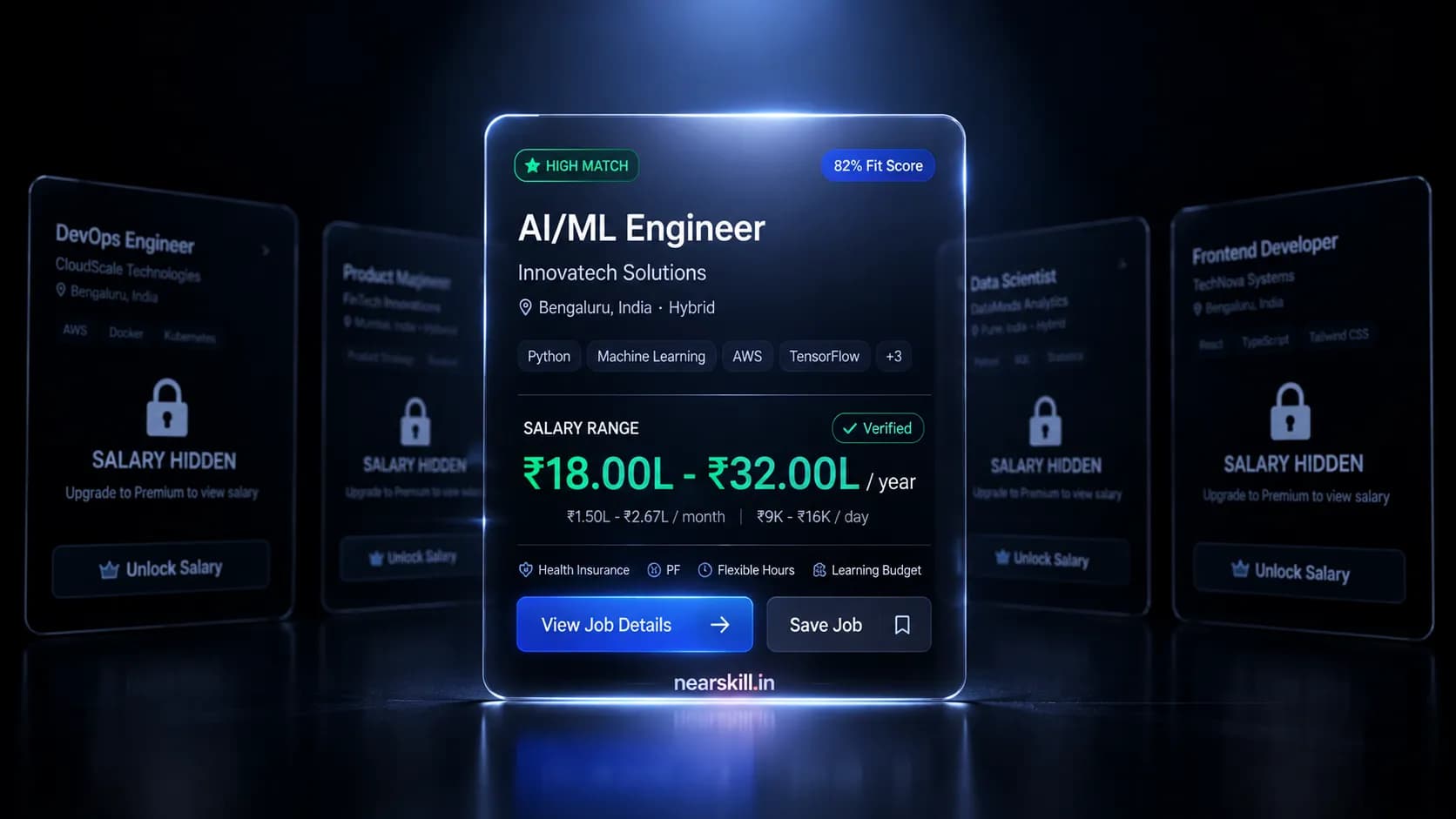
Why Transparent Pay Matters in Tech and AI Jobs (and How to Use It)
A published pay range is the cheapest signal in a job posting. Here is how to read it, use it in negotiations, and what to do when it is missing.
Find the roles that actually fit you
Upload your resume and get every live role ranked by fit score, with pay ranges attached. Free, no account, results in seconds.