


How AI Job Matching and Fit Scores Actually Work (and How to Improve Yours)
Fit scores measure the overlap between your skills and a job record. Here is the pipeline behind them, their real limits, and how to use the number.

Founder, NearSkill
On this page
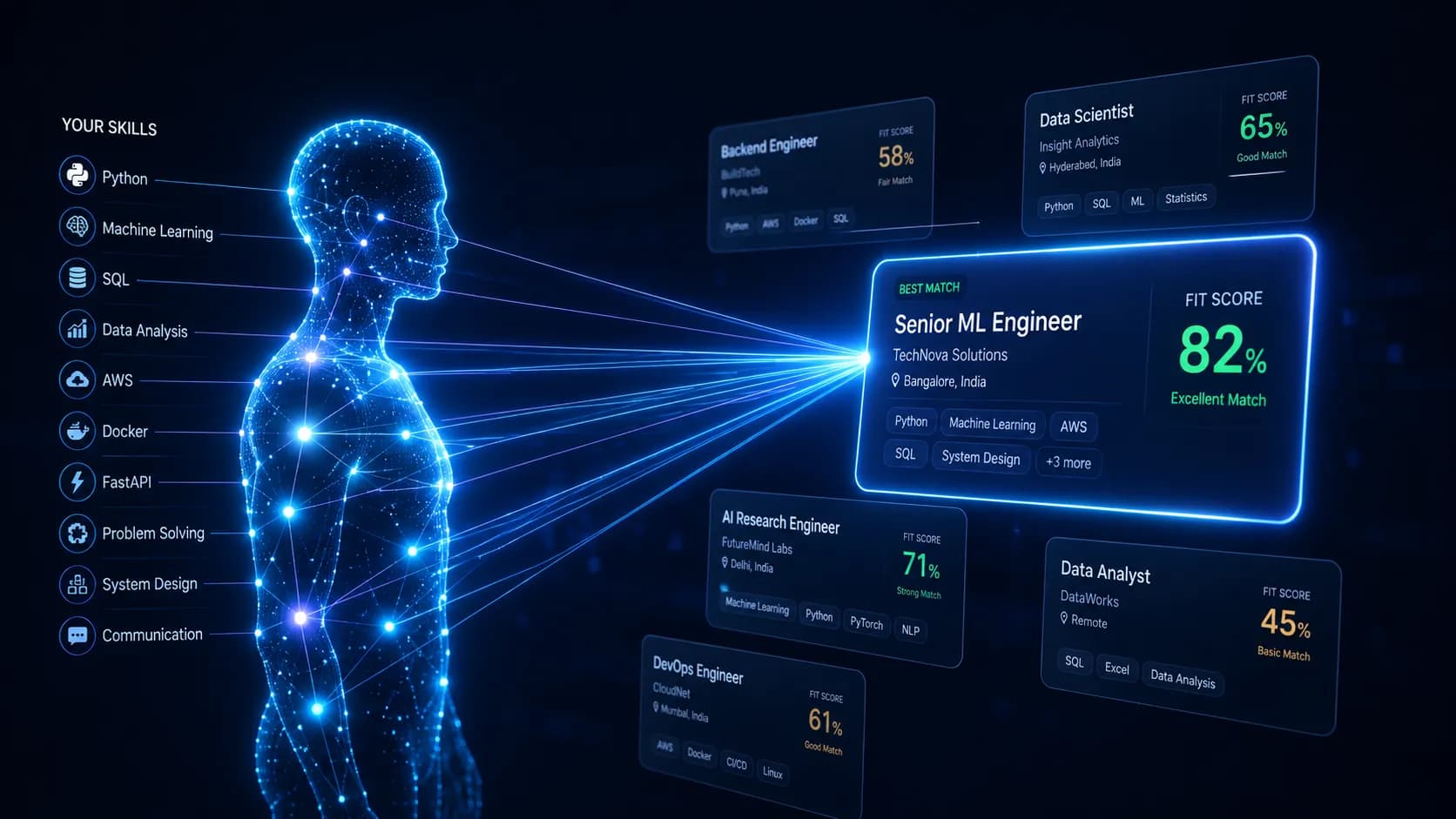
A fit score is an overlap calculation. The engine reads your resume, turns it into a skill profile, then compares that profile against a structured record of each job: required skills, seniority, industry, and location. The percentage you see is how much of the job record your profile covers, weighted by importance. This guide explains the AI job matching pipeline, its real limits, and what the number is actually good for.
The four-stage pipeline behind every score#
- Parse. Your resume is converted into structured fields: skills, tools, years of experience, education, job titles, industries.
- Normalize. Synonyms are collapsed. "ML", "Machine Learning", and "machine-learning" become the same entity. Job titles map to seniority levels.
- Compare. Each live job record is checked against your profile. Every skill the job lists is weighted, usually by how often it appears in similar roles.
- Rank. The weighted overlap becomes a score, and jobs sort by it. The strongest matches surface first, and the weakest are filtered out.
The entire pipeline runs in seconds because the comparison happens against a normalized job index, not against raw postings. On NearSkill, every role is enriched into a fixed 21-field schema before it is ever matched, which is why two jobs from two different employers can be compared side by side at all. Messy postings with missing pay, buried seniority, and twelve irrelevant technologies become records with the same fields, the only thing a fit score can read. From structuring thousands of specialized AI training and domain-expert roles on NearSkill, the normalize stage is where most matching accuracy is won or lost: two postings for the same role can name a skill four different ways, and only normalization makes them comparable.
What the score actually measures#
| Signal | Weight | Why it matters |
|---|---|---|
| Required and preferred skills | Highest | Direct overlap with the job record |
| Seniority and title level | High | Matches the responsibility band the employer set |
| Years of experience | Medium | Sanity-checks the seniority signal |
| Industry and domain | Medium | Domain experts match specialized roles better |
| Location and remote fit | Low–medium | Filters for where the role can be filled from |
Notice what is not in the table: salary alignment, team culture, visa status, and whether the employer is actually hiring. No scoring engine can read those from a resume. That is not a flaw in the math; it is a boundary. A fit score answers one question: how much does my profile overlap with this job record? Everything else stays in the job posting, and you should read it.
Why two platforms give you two different scores#
The same resume can score 78% on one platform and 61% on another. Three differences cause most of the gap:
- Parsing quality. One engine recognizes "PyTorch" buried in a project bullet; another misses it entirely.
- Skill weighting. Some engines weight every listed skill equally. Others weight the skills that appear most in the market, so a rare skill moves your score more.
- Seniority handling. Engines differ on whether "Staff Engineer" and "Engineering Manager" map to the same level.
None of this makes scores useless. It makes them within-platform ranking tools. Use one platform to order your applications, then check the posting details on each job before applying. The practical playbook is in the fit score improvement guide.
The limits, stated plainly#
- Scores cannot see salary fit. A 90% match on a role paying 40% below your current band is still a bad application. Check pay before you apply; NearSkill shows published ranges on every match card, and transparent pay is worth more than any score.
- Scores cannot see visa reality. Match engines do not know your work authorization unless you tell them. Filter manually.
- Scores reward match, not demand. A perfect match can still be a role with heavy competition and low conversion.
- Stale resumes score stale. The score is a snapshot of your resume. It updates when the resume updates, not when you learn a new skill.
Use the 70/50 rule: 70%+ is a strong match worth a tailored application. 50–70% is a reach worth a look. Under 50% is a mismatch, usually because the role asks for skills or seniority you do not have. Applying anyway wastes the same time a tailored application would have used.
How to read your results like a professional#
- Sort by score and apply to the top 10 first; they are where your profile does the most work.
- For each top match, open the full posting and check pay, location, and contract type against your constraints.
- Group your next 10 by the missing skill. One shared gap explains ten lower scores.
- Update the resume with the exact skill names from those postings, then re-run the match.
The loop is the whole game: match, read the posting, fix the profile, match again. Scores improve because the profile improves, and the profile improves because you read jobs like a matcher does. The resume guide for AI roles shows how to write bullets that parse cleanly.
A worked example: why one skill gap costs so much#
Take a senior data engineer with seven years of experience and a score of 78% on a role. The posting lists five required skills: Python, SQL, Airflow, Spark, and Kafka. Our engineer has all but Kafka. The missing skill costs more than one-fifth of the score, because required skills are weighted against the whole record:
| Signal | Weight | Matched? | Contribution |
|---|---|---|---|
| Python | Required, heavy | Yes | 20% |
| SQL | Required, heavy | Yes | 20% |
| Airflow | Required, heavy | Yes | 20% |
| Spark | Required, medium | Yes | 12% |
| Kafka | Required, heavy | No | 0% |
| Seniority & experience | Context | Yes | 6% |
| Total | 78% |
Now the important part: the 78% is a ranking number, and this person is still the strongest applicant if the hiring manager sees Kafka as trainable. The score never says "do not apply". It says "this role asks for something you do not have; decide whether that matters". Most hiring managers hire for 70% of the list. The score is doing its job by making the gap visible instead of surprising you in the third interview round.
Scoring versus filtering: why your list shrinks#
Engines do two different things, and users confuse them. Scoring ranks every job against your profile. Filtering removes jobs by hard rules: location, employment type, visa sponsor, pay floor. A score of 85% on a role in another country is still a 0% application if you cannot work there, and no scoring system fixes that.
The professional workflow treats them separately: filter first by the constraints that are absolute for you, then score the remainder, then read the top postings in full. On NearSkill the filters and the score run in the same pass, so AI Job Match returns ranked results that already respect your location and contract preferences.
How matching engines are trained and updated#
The weighting in the comparison stage is not magic. It comes from two sources: job posting statistics (which skills correlate with which roles across thousands of listings) and feedback signals (which matches led to applications and hires). The model re-learns on a schedule, which is why scores can shift slightly without your resume changing. A role that added a new required skill yesterday scores lower today, and a skill the market started treating as table stakes gains weight across the board.
The practical consequence: scores are freshest right after the job index updates, and stale profiles lose ground as the market moves. Re-running your match on a schedule, weekly or monthly, is not paranoia. It is the difference between matching the market you have and matching the market from a month ago.
The bottom line#
Fit scores are weighted overlap calculations between your parsed resume and structured job records. They rank jobs for you, they cannot see salary, culture, or visa reality, and they differ across platforms. Used correctly, they cut your application list from hundreds of postings to the ten where your profile does the real work.
Next step: upload your resume and see your fit scores against every live role in under 20 seconds, with pay ranges attached. No account.
See your real fit scores
Upload your resume and get every live tech and AI role ranked by fit, with transparent pay ranges on each match. Free, no account, results in seconds.
Written for real AI training and domain expert candidates. No fluff, no recycled job board advice.
Frequently asked questions
How is a job fit score calculated?
The engine parses your resume into a skill profile, then compares it against a structured record of each job: required skills, seniority, industry, and location. The fit score is the weighted overlap between the two, expressed as a percentage. 70% and above is a strong match.
Are fit scores the same across job platforms?
No. Each platform weighs skills, experience, and seniority differently, and each parses resumes differently. A 78% on one platform can be a 62% on another. Treat scores as a ranking tool within one platform, not an absolute measure of your suitability.
What do fit scores miss?
Scores do not measure salary alignment, team culture, visa eligibility, or how much a company actually wants to hire. A high score means skill overlap, not a guaranteed interview. Use the score to prioritize applications, not to skip the posting details.
Why is my fit score lower than I expected?
Usually because the job record asks for skills your resume states differently, or because the resume mixes seniority signals. Naming skills exactly as the job does, adding a seniority line, and removing unrelated keywords raises the score quickly. See the fit score improvement guide.

Ankit Kumar
Founder, NearSkill
Ankit Kumar is the founder of NearSkill, an AI-powered career matching engine for specialized tech and AI roles, including generative AI training, domain expert evaluation, data science, and advanced software engineering. He built NearSkill after watching the specialized AI job market fragment into postings with missing pay, inconsistent skill requirements, and no way to compare roles side by side. His guides cover AI trainer and domain expert compensation, resume strategy for evaluation roles, how fit scores work, and the skills that matter in generative AI training work.
Related guides
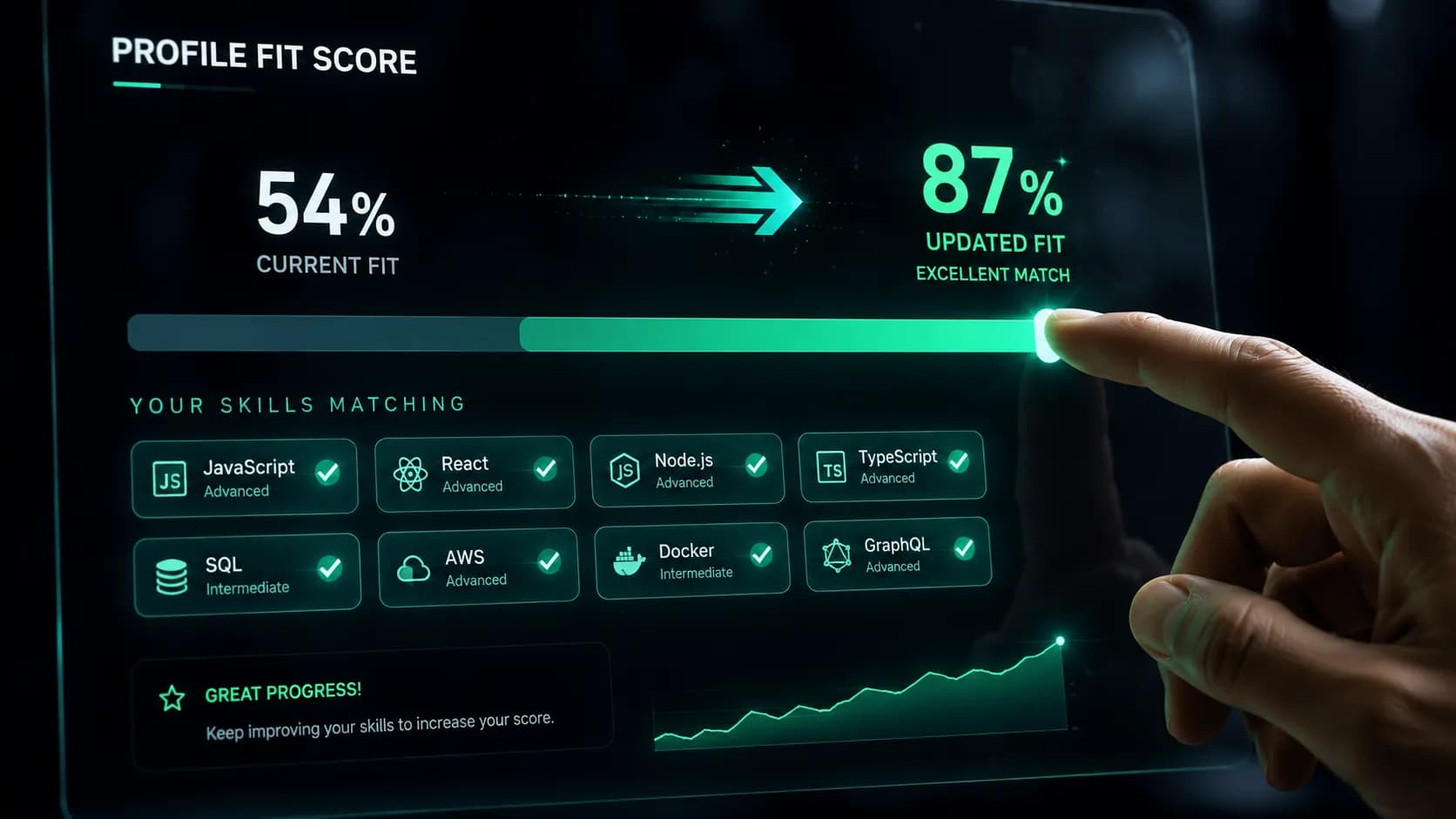
How to Improve Your Fit Score for Specialized Tech and AI Roles
Six concrete moves raise a fit score: exact skill names, a seniority line, quantified bullets, less noise, the right roles, and honest keywords.
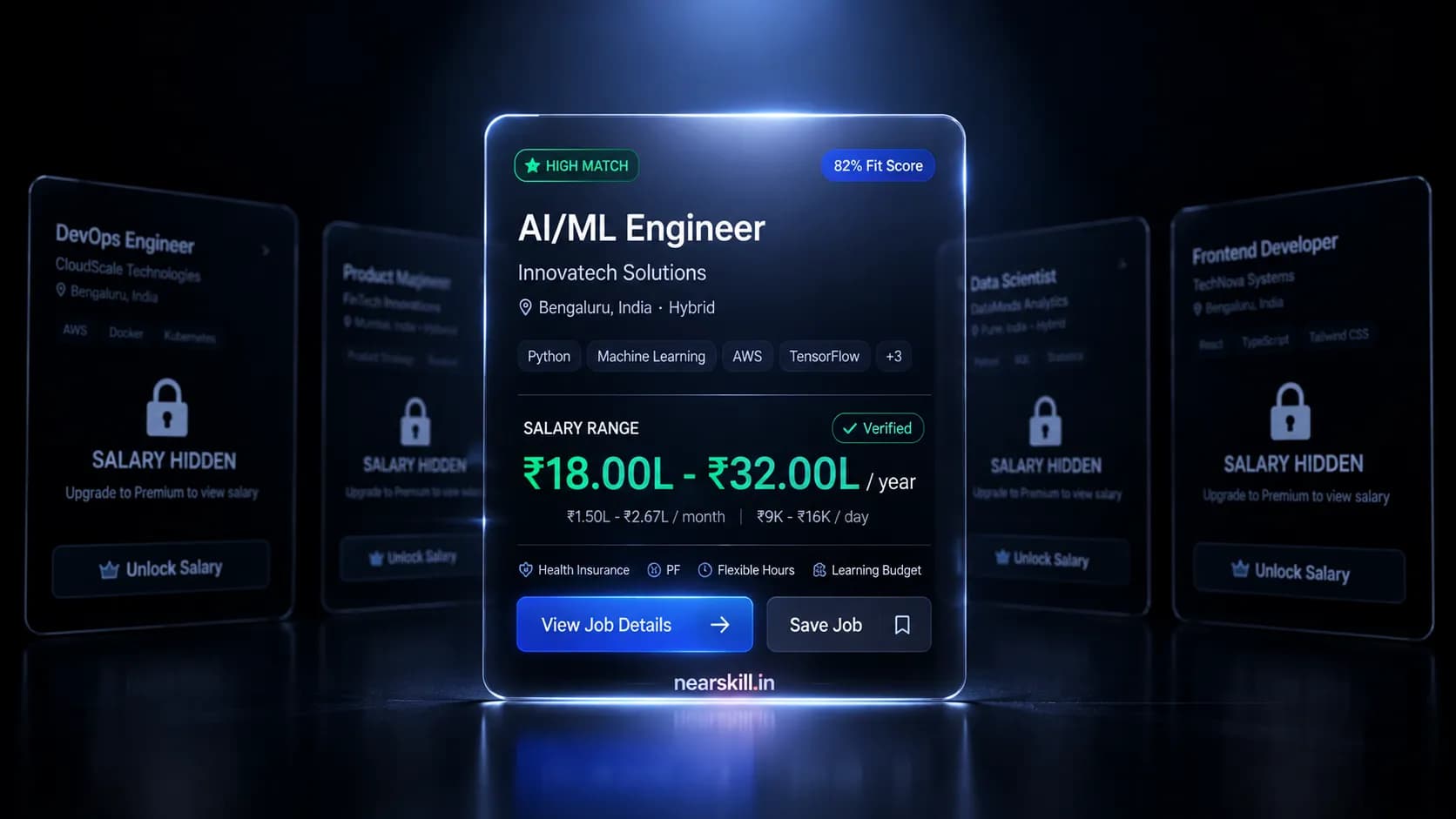
Why Transparent Pay Matters in Tech and AI Jobs (and How to Use It)
A published pay range is the cheapest signal in a job posting. Here is how to read it, use it in negotiations, and what to do when it is missing.

How to Write a Resume That Works for AI Training and Domain Expert Roles
AI evaluation jobs screen for precision, domain depth, and clear writing. A resume that proves those three beats a longer one that only lists duties.
Find the roles that actually fit you
Upload your resume and get every live role ranked by fit score, with pay ranges attached. Free, no account, results in seconds.