


AI Training Platforms Reviewed 2026: Mercor, Micro1, Turing, Outlier, DataAnnotation & More
Are AI training platforms legit in 2026? Verified pay ranges, worker-reported patterns, and red flags for Mercor, Micro1, Turing, Outlier, DataAnnotation, Handshake AI, Alignerr, and Surge AI.

Founder, NearSkill
On this page
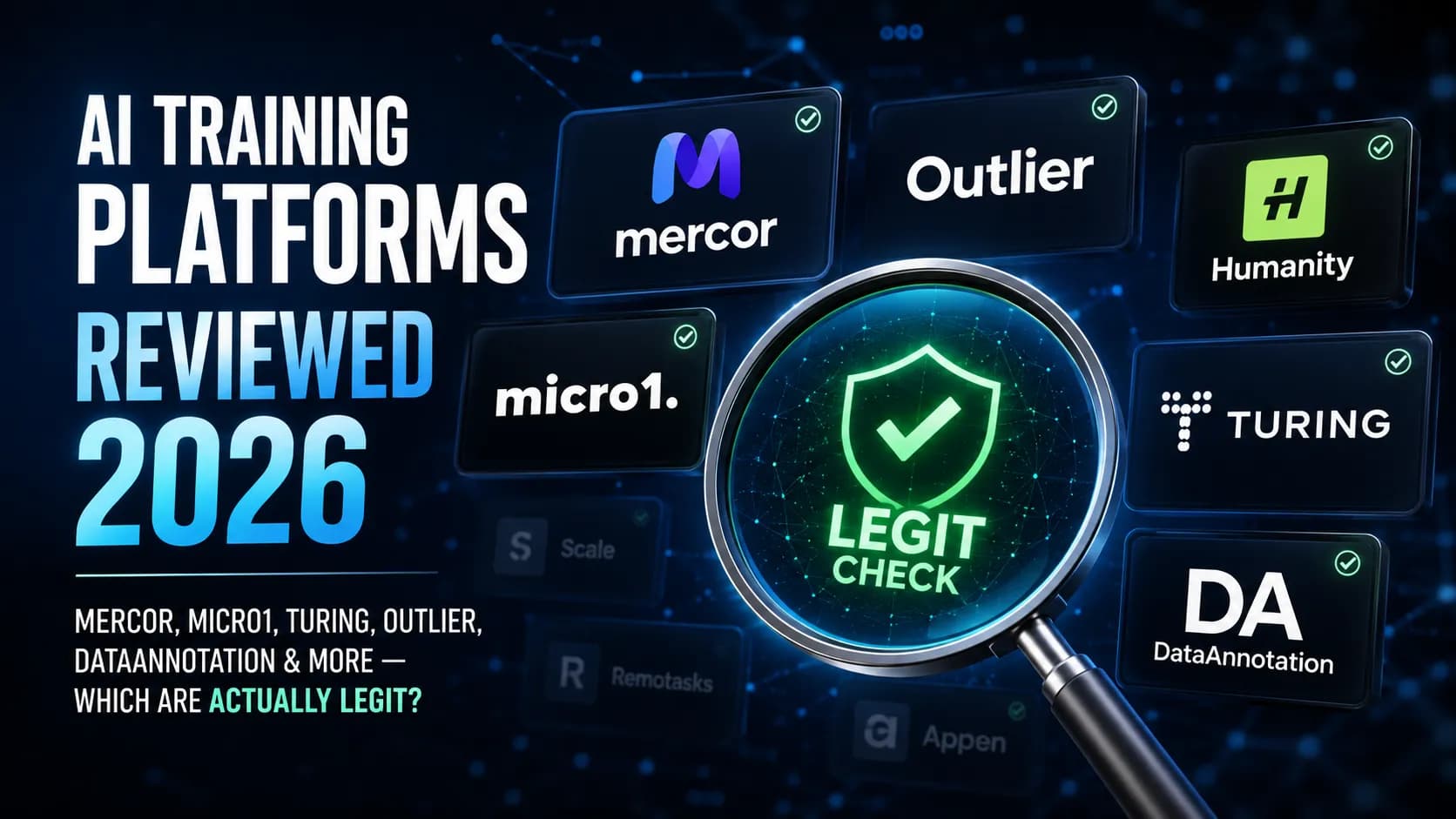
Frontier labs need human judgment at scale, and a platform market grew up to supply it. The growth created a confusing middle: generalists earning $20/hr next to doctors and lawyers earning $100+/hr. The common question is fair: are these platforms legit, and which are worth your time in 2026? Each section below gives one platform the full treatment: what it is, whether it is legitimate and why, realistic pay, screening, payment, real complaints, and a clear apply-or-skip verdict.

Mercor
AI talent marketplace connecting experts to frontier labs
What it actually is
Mercor connects 30,000+ domain experts (doctors, lawyers, scientists, senior engineers) with frontier labs that need data labeling, model training, and evaluation work. Founded in 2022 by three Thiel Fellows, it raised $350M at a $10 billion valuation in October 2025 (CNBC) and pays out $1.5 million a day to contractors.
NearSkill structures roles from Mercor’s pipeline directly, so this is the platform we get asked about most. The bottom line: the rates are real, the company is real, and the risk profile is real too.
Is it legitimate?
Yes, Mercor is a legitimate, heavily funded company with documented payouts. "Legit" and "low risk" are different questions here.
- Backed by Felicis, Benchmark, General Catalyst, and Robinhood Ventures at a $10B valuation (CNBC, Oct 2025).
- Pays out $1.5 million daily and reports $450–$500M in annualized revenue.
- Two documented caveats: a late-2025 contractor cut where thousands were re-invited to a renamed project at roughly $5 less per hour (Business Insider), and the March 2026 LiteLLM supply-chain breach that exposed contractor records including ID scans and interview videos (TechCrunch, Fortune).
Realistic pay in 2026
The highest expert rates in this guide: $50–$150/hr, with an advertised average above $85/hr.
| Domain experts (typical) | $50–$150/hr |
| Advertised average | $85+/hr |
| Generalist project work | $16–$100+/hr |
| Reported cut (Meta project, late 2025) | $25–$30 → ~$5 less/hr |
Who it works best for
Application and screening
- 1Apply with a resume and GitHub or portfolio links.
- 2Complete an AI video interview that probes your domain and reasoning.
- 3Pass a trial project at a lower rate before the full rate applies.
- 4Get matched to project queues; weekly payouts follow.
Payment reliability and speed
Weekly, in USD. Payment records are strong overall, but the late-2025 cut left thousands with no payout runway when the project ended. Cash out weekly and never budget on one project.
Pros
- Highest expert rates in the market
- Direct contracts with OpenAI, Anthropic, Meta, Google
- Real daily payouts, weekly schedule
- Serious funding backing the operation
Cons
- Documented pay-cut history on project transitions
- 2026 data breach exposed ID scans and interviews
- AI interviews that some call expertise harvesting
- Project churn; no guaranteed pipeline
Common complaints from real workers
- Ghosting after AI interviews: candidates report slow or silent outcomes.
- The pay-cut wave: contractors told Forbes it felt like "a third off their wages".
- Breach fallout: if you applied before March 2026, assume your data was exposed. Freeze your credit and rotate passwords.
- Invasive session monitoring and a trade-secret lawsuit from Scale AI.
Verdict: Mostly legit with caveats
Apply if
you hold verifiable credentials, want top-of-market rates, and can tolerate project churn with a diversified income.
Skip if
you cannot accept ID scans and video interviews, or you need a stable pipeline to build on.
Sources: CNBC · Business Insider · Forbes · TechCrunch · Fortune

Micro1
Remote-first AI talent marketplace with the best worker ratings
What it actually is
Micro1 matches vetted engineers, STEM professionals, and domain experts to AI training and evaluation projects for US companies. It bills itself on rigor: government ID verification, multi-stage screening, and a claim that it accepts the top 1% of applicants.
It is the outlier of this review in a good way. On Indeed it holds 4.8/5 across 112 reviews (August 2026), with pay and benefits rated 4.8/5, management 4.8/5, and 100% of surveyed workers saying they are paid fairly. That is the strongest worker record of any platform in this guide.
Is it legitimate?
Yes. Micro1 is legitimate, and its worker reviews are the best evidence: 4.8/5 on Indeed with 100% of surveyed workers reporting fair pay.
- Indeed: 4.8/5 across 112 reviews, pay and benefits 4.8/5 (August 2026).
- Workers praise flexibility, remote work, and on-time biweekly payments.
- The documented caveat is honesty from the platform itself: certification does not guarantee work.
Realistic pay in 2026
AI trainer roles $20–$40/hr, evaluation specialists $22–$70/hr, AI/ML engineers $70–$150/hr. You set your own billing rate at registration.
| AI trainer / annotator | $20–$40/hr |
| AI evaluation specialist | $22–$70/hr |
| AI/ML engineer | $70–$150/hr |
| UK average (Glassdoor) | ~£20/hr |
Who it works best for
Application and screening
- 1Register and set your own billing rate within market expectations.
- 2Complete the vetting: technical assessments plus government ID verification.
- 3Earn a certification badge after passing.
- 4Get matched to projects; certification alone does not guarantee placement.
Payment reliability and speed
Biweekly, on time, through the platform. Payment is the strongest-reviewed aspect of Micro1: no dispute patterns in the 2026 review data.
Pros
- Best worker ratings in the group
- You set your own rate
- On-time payments, no dispute patterns
- Strong management and culture reviews
Cons
- Selective: top 1% claim, ID verification required
- Certification does not guarantee a live project
- Income gaps between engagements
Common complaints from real workers
- Overhiring: "even if you get certified, getting work is a challenge" is the recurring critical review.
- Gaps between contracts are real, and onboarding can feel overwhelming.
- Regional pay disparities: US and UK workers earn more than other markets.
Verdict: Legit
Apply if
you are a qualified technical worker who wants fair, on-time pay and can pass a demanding vetting process.
Skip if
you are a beginner, or you need guaranteed hours from day one.
Sources: Indeed (112 reviews, Aug 2026) · Glassdoor · Micro1 job postings

Turing
AGI infrastructure company with a steady, standardized pipeline
What it actually is
Turing, founded 2018 with $140M+ raised, pivoted from developer placement into an AGI infrastructure company that hires engineers and domain experts to train models for Fortune 500 clients. It runs two products: short freelance AI training contracts and longer developer placements.
Its pay is standardized rather than negotiated. A July 2026 benchmark of 2,628 listings across eight platforms (aitrainer.work) found Turing at a median of $27/hr with the narrowest rate corridor studied.
Is it legitimate?
Yes. Turing is a legitimate, venture-backed company with real clients and documented payouts. The 2026 complaints are about payment speed, not payment itself.
- Founded 2018, $140M+ raised, contracts with Fortune 500 companies.
- Documented payouts across biweekly and monthly cycles.
- Trustpilot 2.8/5: the dominant complaint is withdrawal delays, which reviewers describe as a payments-operations problem rather than a scam.
Realistic pay in 2026
AI training listings $15–$75/hr with a median of ~$27/hr; finance experts $80–$150/hr; medical and science experts $70–$110/hr.
| AI quality analyst (language) | $15–$20/hr |
| LLM trainer (Glassdoor) | ~$30/hr |
| Medical specialist (evaluation) | $40–$75/hr |
| Finance expert | $80–$150/hr |
| Medical / science expert | $70–$110/hr |
Who it works best for
Application and screening
- 1Apply and complete a 45-minute analytical challenge.
- 2Pass a 30-minute writing assessment (non-coders) or LeetCode-style coding tests (developers).
- 3Complete onboarding: 5–14 days to start.
- 4Work 1–3 month contracts with a 2–5 hour daily PST overlap.
Payment reliability and speed
USD, biweekly or monthly depending on the engagement. The recurring 2026 complaint is withdrawal delays of weeks to months; keep your own hours log and chase balances early.
Pros
- Steadiest pipeline in the group
- Real Fortune 500 clients
- Standardized, predictable pay
- Clear vetting process
Cons
- Median ~$27/hr is below expert market rates
- Withdrawal-delay complaints in 2026
- PST overlap required daily
- 1–3 month contracts only
Common complaints from real workers
- Payment withdrawal delays (a July 2026 reviewer reported waiting over two months).
- Short contracts with no continuity guarantee.
- No feedback on rejected applications.
- The mandatory 2–5 hour daily PST overlap is a dealbreaker for many.
Verdict: Legit
Apply if
you want volume and predictability over top rates, and you can hold a daily PST overlap.
Skip if
your expertise commands expert-market rates, or your timezone makes a daily PST overlap painful.
Sources: aitrainer.work benchmark · Glassdoor · Trustpilot · Turing listings

Outlier
Scale AI’s consumer platform: high ceilings, high chaos
What it actually is
Outlier is Scale AI’s consumer-facing AI training platform, with 700,000+ contributors and $500M+ documented payouts. Projects span RLHF preference ranking, code review, creative writing evaluation, and math reasoning, each with its own guidelines, Slack channel, and quality team.
The description that fits best, from Joshua Drake who tracks this market at BreakingEven: "If DataAnnotation is a quiet library, Outlier is a chaotic warehouse." High ceilings, empty queues, and unexplained removals are all part of the same package.
Is it legitimate?
Yes, Outlier is legitimate: it is owned by Scale AI, a $1B+ funded company. The work and the pay are real; the worker experience is the roughest of the group.
- Owned by Scale AI; 700,000+ contributors and $500M+ paid out.
- Documented weekly pay cycle: Tuesday–Monday UTC, received by Friday, via PayPal, AirTM, or ACH.
- 2026 record: mass deactivations around April 20 with withheld earnings, and the July Aether wind-down with reports of unpaid logged hours.
Realistic pay in 2026
Documented by tier: RLHF $15–$25/hr, writing $20–$35/hr, coding $30–$50/hr, STEM $35–$60/hr, domain experts $40–$60/hr, surge tasks $50–$80/hr.
| Basic RLHF / comparison | $15–$25/hr |
| Writing / creative | $20–$35/hr |
| Code review / generation | $30–$50/hr |
| Advanced math / STEM | $35–$60/hr |
| Specialized domain expert | $40–$60/hr |
| Surge / priority tasks | $50–$80/hr |
Who it works best for
Application and screening
- 1Create an account and complete your profile.
- 2Take a project-specific qualification assessment (live coding for dev roles).
- 3Install Hubstaff time-tracking on some projects (periodic screenshots).
- 4Get assigned to a project; assignment can take days to weeks, with waitlists.
Payment reliability and speed
Weekly, received by Friday. Use PayPal or ACH rather than AirTM, which has documented ID-verification issues (one worker reported $1,023 stuck). Assessments and onboarding are unpaid.
Pros
- Huge volume and task variety
- Real pay ceilings on premium projects
- Weekly pay, multiple methods
- Low barrier to entry
Cons
- Empty queues for days or weeks
- 2026 deactivation waves with withheld earnings
- Hubstaff screenshot tracking on some projects
- Unpaid onboarding and assessments
Common complaints from real workers
- Empty queues: the single most common complaint, with no reliable fix.
- Account removals without explanation; removal posts are 14% of community discussion.
- The April and July 2026 deactivation waves, with some earnings withheld.
- Chatbot-only support and unpaid mandatory training.
Verdict: Mostly legit, volatile
Apply if
you want flexible, remote work with high ceilings and can treat it as one income leg among several.
Skip if
you need predictable weekly volume or cannot tolerate opaque account decisions.
Sources: BreakingEven (Joshua Drake) · Trustpilot · Glassdoor · Indeed

DataAnnotation
The quiet library: published rates, weekly payouts, lowest barrier
What it actually is
DataAnnotation is the reference point of this market because it publishes its rates. It runs a generalist track (text, image, audio) plus coding, STEM, and professional tiers, and reports paying out over $20 million to 100,000+ workers since 2020.
Its review aggregates are the second-strongest of the group: 3.7/5 on Indeed and 3.9/5 on Glassdoor, with workers consistently praising pay fairness and weekly reliability.
Is it legitimate?
Yes. Published rates, weekly payouts, and strong review aggregates make it the lowest-friction legitimate platform in this guide.
- Publishes its own rate bands: $20–$30+/hr generalist, $50–$100+/hr expert (site documentation, 2026).
- $20M+ paid out to 100,000+ workers since 2020.
- Indeed 3.7/5 and Glassdoor 3.9/5, with no payment-dispute pattern.
Realistic pay in 2026
Published rates: $20–$30+/hr generalist, $50–$100+/hr for coding, STEM, and professional domain work. No minimum hours.
| Generalist (text, image, audio) | $20–$30+/hr |
| Coding track | $50–$100+/hr |
| STEM expert track | $50–$100+/hr |
| Professional domain (law, finance, medical) | $50–$100+/hr |
Who it works best for
Application and screening
- 1Submit a short application.
- 2Pass the free written starter assessment.
- 3Get approved within days to a few weeks.
- 4Choose projects from a dashboard; log hours, paid weekly.
Payment reliability and speed
Weekly via PayPal, on an honor-system time log with admin approval before payout. The most reliable payment pattern in this review.
Pros
- Published, honest rates
- Weekly PayPal payouts
- Lowest barrier to entry
- Steadier volume than most
Cons
- Generalist rates cap at ~$30/hr
- Idle periods in slow weeks
- Strict, continuous quality scoring
Common complaints from real workers
- Idle periods when queues thin out.
- Strict quality scoring: one bad batch affects project access.
- Guideline changes arrive without warning.
Verdict: Legit
Apply if
you are new to AI training work or want published rates and weekly pay with minimal friction.
Skip if
you are a credentialed expert who can clear the expert track elsewhere for more; qualify here first, then compare.
Sources: DataAnnotation published documentation · Indeed 3.7/5 · Glassdoor 3.9/5

Handshake AI
The highest pay in the space, and the steepest cliff
What it actually is
Handshake AI, born from the college-careers network, pays credentialed US contractors to evaluate AI responses and write expert answers in law, finance, medicine, and engineering. It is invite-heavy, US-only, and draws workers from a built-in pipeline of university-verified candidates.
The tracker BreakingEven notes $100M+ paid to 100,000+ fellows and confirms the rates are real, not marketing: on a 20-hour week, $80/hr is $1,600, which is why workers call the money life-changing.
Is it legitimate?
Yes, the platform is structurally legitimate with the highest verified pay in the space, and simultaneously the most precarious: mass offboardings, a mid-2026 payment crisis on one project, and opaque account decisions.
- $100M+ paid to 100,000+ fellows; written contracts; no fees to join.
- Tracker data: 7.5% account ban rate, 11.4% empty-queue mention rate, sentiment at 45/100.
- Mid-2026 Project HH crisis: workers reported receiving a fraction of earned pay, with arbitration organizing.
- Hour discrepancies of up to 60+ hours per cycle tied to mouse-movement idle detection.
Realistic pay in 2026
The highest verified band in AI training: a $60/hr floor for credentialed work, $100/hr ceiling, averaging near $80/hr.
| Generalist evaluation | ~$17/hr |
| Evaluation specialist | ~$40/hr |
| Technical roles | $80/hr+ |
| Expert projects (law, medicine, eng) | $100–$125/hr |
| Credentialed average | ~$80/hr |
Who it works best for
Application and screening
- 1Get invited or apply; waitlists are real and can run months.
- 2Verify identity through university records, transcripts, or portfolios.
- 3Pass the gating assessment (R2I) introduced June 2026, with no score or feedback on failure.
- 4Get matched to a project; most projects cap at 10–20 hours a week.
Payment reliability and speed
Weekly via Deel, released Wednesdays; first payout in 2–4 weeks. Document every hour: the platform’s own trackers report logged hours disappearing in some cycles.
Pros
- Highest verified rates in AI training
- Best pay for credentialed experts by a wide margin
- Flexible, fully remote
- Strong onboarding for newcomers to AI work
Cons
- Mass offboarding waves in 2026
- Documented hour and payment disputes
- US-only, invite-heavy, long waitlists
- Trustpilot 1.4/5 (partly conflated with the college platform)
Common complaints from real workers
- Offboarding without warning or explanation; appeals rarely succeed.
- The June 2026 R2I assessment fails confident workers with no appeal path.
- Hour discrepancies from activity tracking.
- A mid-2026 project payment crisis where workers received a fraction of earned pay.
Verdict: Higher risk
Apply if
you are a US-based expert who wants premium rates and will document everything, never treating it as your only income.
Skip if
you need stability, are outside the US, or cannot accept that engagements can end without explanation.
Sources: BreakingEven (Joshua Drake) · Business Insider (Aug 2026) · Trustpilot

Alignerr
Labelbox’s freelance arm: real parent, project-shaped reality
What it actually is
Alignerr is the freelance workforce arm of Labelbox, an enterprise labeling company valued around $3.2B. Workers apply to specific projects and work inside Labelbox tools, returning to the job board when a project ends.
That parentage is why it passes the legitimacy test: real company, identity verification through Persona, payments through Deel and PayPal, and a 4.6/5 Trustpilot across roughly 3,000 reviews. Its own community tells the fuller story: unpaid evaluation phases, a 3% acceptance rate, and long waits between projects.
Is it legitimate?
Yes. Alignerr is legitimate and owned by a real, well-funded company. The honest picture is project-based work with long gaps and unpaid evaluation phases.
- Owned by Labelbox, valued around $3.2B; identity via Persona; payments via Deel and PayPal.
- Trustpilot ~4.6/5 across ~3,000 reviews; its subreddit documents unpaid evaluations and account closures.
- A February 2026 acquisition of the recruiting startup Upcraft shifted onboarding toward the Outlier model, which contractors have noticed.
Realistic pay in 2026
Advertised $25–$50/hr; community-tracked reality is $15–$60/hr averaging around $37/hr.
| General AI preference feedback | $15–$25/hr |
| Domain projects (STEM, technical) | $25–$45/hr |
| Advanced coding | $40–$60/hr |
| Voice / audio (per finished hour) | $35–$45/hr, ~$9/hr real labor |
Who it works best for
Application and screening
- 1Apply to a specific project on the job board.
- 2Pass a one-shot assessment with camera and screen monitoring (3% acceptance).
- 3Verify identity (US IDs only).
- 4Work inside Labelbox; reapply when the project ends.
Payment reliability and speed
Weekly via PayPal (Wednesday–Friday) or biweekly via Deel. Some projects gate payment on reviewer acceptance, which risks unpaid hours.
Pros
- Real parent company (Labelbox)
- Decent Trustpilot record
- Focused, project-based work
- Published rate bands
Cons
- Long gaps between projects
- Unpaid evaluations and onboarding
- Strict one-shot vetting
- US-only verification
Common complaints from real workers
- Unpaid evaluation phases of 3–6 hours are a documented pattern, not an edge case.
- Waitlist purgatory: acceptance and work are different events.
- No task notifications, so workers miss task waves.
- Effectively US-only for identity verification.
Verdict: Mostly legit with caveats
Apply if
you want project-based work with a real parent company and can afford weeks-long gaps.
Skip if
you need steady volume or are outside the US.
Sources: BreakingEven · Trustpilot · RemoWork · GigFish
Surge AI
The boutique RLHF specialist for frontier labs
What it actually is
Surge AI is a bootstrapped RLHF and data-labeling specialist (about $1.4B ARR in 2025) whose clients include Anthropic, OpenAI, Google, Meta, and Microsoft, and which built the GSM8K math benchmark. It supplies expert-annotated training data and human feedback to frontier models.
This is the enterprise end of the market: verified experts only, matched to tasks by domain, with real quality dashboards and inter-annotator agreement tracking. It is not designed for beginners.
Is it legitimate?
Yes. Surge AI is legitimate, profitable, and works with every major frontier lab. Entry is the barrier: it hires verified experts and remains highly selective.
- Clients include Anthropic, OpenAI, Google, Meta, and Microsoft; built the GSM8K benchmark.
- About $1.4B ARR in 2025 with a global network of 50,000–100,000+ contract annotators.
- A pending contractor-classification lawsuit in San Francisco Superior Court is part of its 2026 picture.
Realistic pay in 2026
Baseline around $18–$24/hr for approved contributors; premium rates for specialized expert review.
| Approved contributor baseline | ~$18–$24/hr |
| Specialized expert review | Premium, project-dependent |
| Medical / legal specialist work | Reported up to hundreds/hr |
Who it works best for
Application and screening
- 1Apply with advanced credentials and domain proof.
- 2Undergo expert verification and assessment.
- 3Get matched to client projects by domain.
- 4Work task-based with strict timers and quality dashboards.
Payment reliability and speed
Paid per task or per working minute; enterprise rails. Reviews note slow communication and inconsistent availability rather than non-payment.
Pros
- Work for every major frontier lab
- Premium pay for expert work
- Cutting-edge tasks and benchmarks
- Verified, expert-only pool
Cons
- Highly selective, PhD-level bar
- Availability not guaranteed
- Not for beginners
- Pending class action over classification
Common complaints from real workers
- Work availability is not guaranteed week to week.
- Strict project timers and only paid-for-accepted-work policies.
- Slow communication and stressful deadlines.
- A pending worker-classification class action.
Verdict: Legit, highly selective
Apply if
your specialty matches frontier-lab needs and you want premium, intellectually demanding work.
Skip if
you are a generalist or need steady weekly volume.
Sources: RemoWork · BreakingEven · Glassdoor ~3.7/5 · company disclosures
Patterns that hold across every platform#
- Pay tracks expertise, not effort. Generalist work clusters at $15–$30/hr everywhere; credentialed expert work at $40–$150/hr. The domain expert pay guide explains the mechanics.
- Project availability is never guaranteed. Every platform has queue gaps. The difference is the size of the gaps, not their existence.
- Unpaid assessments are the norm. Expect 30 minutes to 6 hours of assessments and onboarding with no pay.
- Payment discipline is yours. Cash out weekly, keep your own hours log, screenshot task completions.
- Taxes are yours. Independent contractor income means self-employment tax in most countries. Set aside 25–30% from the first payout.
Red flags that separate real platforms from scams#
- Any fee to apply, train, or "certify". No legitimate platform charges workers. The fee is the scam.
- Pay only in crypto. Real platforms use PayPal, bank transfer, Deel, or payroll providers.
- No quality gate. Legitimate AI training work always has an assessment. Instant approval means your data is the product.
- Vague task descriptions with big numbers. "$500/day with no experience" is a bait rate.
- Pressure to share more than needed. Requests for banking credentials or full machine access are never legitimate.
How to choose the right platform for you#
Your background decides your starting point more than platform marketing does. The decision tree below summarizes the paths; the steps after it add the context.
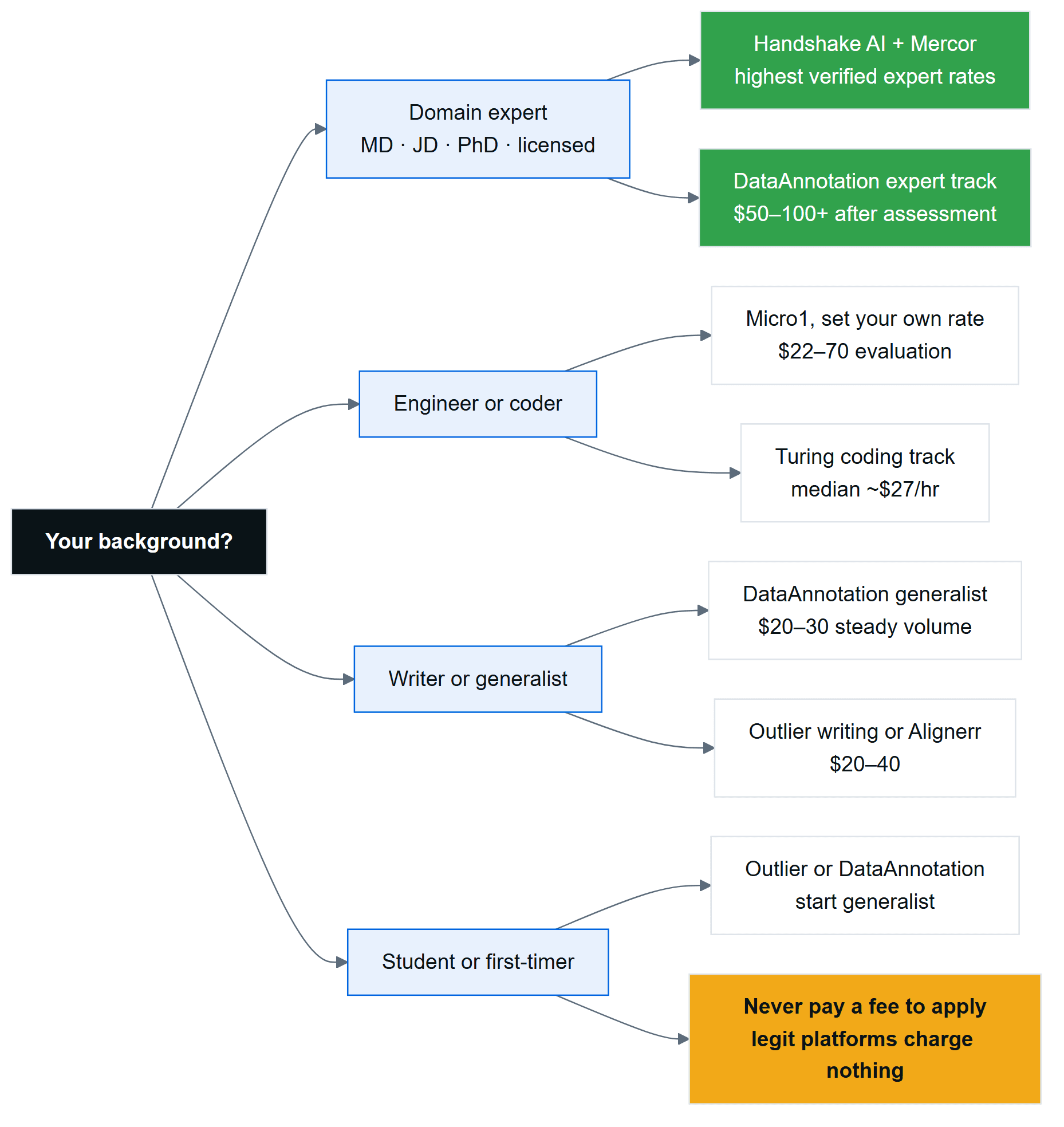
- Credentialed expert? Start with Handshake AI and Mercor for the highest verified expert rates, and keep DataAnnotation’s expert track as a volume base. Add Surge AI only if your specialty matches its client needs.
- Engineer or coder? Micro1 lets you set your rate and has the best worker ratings. Turing adds a steady pipeline at standardized pay. Outlier’s coding tier is a flexible third.
- Strong writer or generalist? DataAnnotation offers the steadiest generalist volume at published rates. Outlier writing and Alignerr are reasonable seconds with wider queues.
- Student or first-timer? Pass DataAnnotation or Outlier’s assessment first and build a quality history. Expert-gated platforms will wait until you can show one.
- Never start with one platform only. Two applications in week one beat one perfect application.
How NearSkill fits in#
NearSkill does not replace these platforms, and it is not another review blog. It is the structured layer above them: NearSkill enriches roles from verified sources, including Mercor, Micro1, and Turing pipelines, into one fixed schema, then scores every live role against your resume with a fit score and attaches the pay data we can verify. Instead of re-entering your details on eight platforms, you see their roles side by side in one place, with pay visible or visibly missing. The AI Job Match tool runs the comparison in under 20 seconds, free and without an account.
One honest boundary: NearSkill lists the roles these employers and partner programs publish, and the platform-level caveats in this guide apply to those roles. We structure what is posted; the queue and the quality score remain the platform’s.
Final recommendations: where to start#
- New to this work: apply to DataAnnotation and Outlier in the same week. Pass one assessment, build 50+ accepted tasks, then add a second platform.
- Technical worker: Micro1 first, Turing second. Set your rate honestly and keep a portfolio of accepted evaluations.
- Credentialed expert: Handshake AI and Mercor for rate, DataAnnotation expert track for volume. Expect slower onboarding and document everything.
- Everyone: cash out weekly, log your own hours, set aside 25–30% for tax, and never pay a fee to any platform. The remote work guide covers the funnel in detail.
The bottom line#
All eight platforms reviewed here are legitimate companies that pay real money. The real difference is between "legitimate" and "steady": DataAnnotation and Micro1 lead on reliability, Handshake AI and Mercor lead on rate, and Outlier offers volume with the most chaos. Pick by background, apply to two, cash out weekly, and treat every platform as one leg of a blended income until your own six-month history says otherwise.
Next step: browse live AI training roles from verified sources, or upload your resume to see which roles and platforms score highest against your actual profile.
Sources and methodology#
Compiled from the following primary sources, all accessed August 27, 2026: CNBC (Mercor funding), TechCrunch and Fortune (Mercor breach), Business Insider (Mercor cuts, Handshake AI), Forbes (contractor accounts), BreakingEven by Joshua Drake (platform tracking), aitrainer.work (July 2026 pay benchmark of 2,628 listings), DataAnnotation’s published documentation, Indeed/Glassdoor/Trustpilot aggregates, and NearSkill’s structured role data from Mercor, Micro1, and Turing. Rates are USD and move with demand; figures marked "reported" or "documented" come from the cited sources and have not been independently verified by NearSkill. Rating meters (1–5) are NearSkill’s editorial assessment from the cited evidence. No affiliate links; nothing here is paid placement.
See these platforms’ roles in one place
Upload your resume and get every live AI training and evaluation role ranked by fit score, with verified pay data attached. Free, no account, results in seconds.
Written for real AI training and domain expert candidates. No fluff, no recycled job board advice.
Frequently asked questions
Are AI training platforms legit in 2026?
The eight platforms reviewed here are real companies that pay real money. Legitimacy and steady work are different questions. Every one of them has volume gaps, quality gates, and documented contractor complaints. None of them charges you to join.
Is Mercor a scam?
No. Mercor is a $10 billion company paying out $1.5 million a day to contractors. The caveats are serious: a late-2025 contractor cut with rehires at lower pay, a March 2026 supply-chain breach exposing contractor data, and an ongoing trade-secret dispute with Scale AI.
Do these platforms actually pay?
Yes, with documented exceptions. DataAnnotation, Micro1, and Mercor have the strongest payment records. Outlier withheld earnings around deactivations in April and July 2026, Handshake AI had a mid-2026 payment crisis on one project, and Turing has recurring withdrawal-delay complaints. Cash out weekly and keep your own hours log.
How much do AI training platforms pay in 2026?
Realistic rates: $15–$40/hr generalist, $25–$60/hr coding and STEM, $40–$150/hr credentialed experts. A July 2026 benchmark of 2,628 listings found Turing at a median of $27/hr. Handshake AI’s $60/hr credentialed floor is the highest verified in the space.
Which AI training platform is best for beginners?
DataAnnotation and Outlier: no degree required, written assessments, documented rate floors. Micro1 and Turing are selective. Handshake AI, Surge AI, and Mercor’s expert track expect credentials. Start with one platform, pass its assessment, and build a quality history before adding a second.
Do AI training platforms steal my data?
Platforms collect resumes, ID documents, and work samples, and the March 2026 Mercor breach showed those records are valuable targets: video interviews, passports, and Social Security numbers were exposed. Share only what an application requires, and treat ID scans as sensitive.
Can AI training work be my main income?
Treat it as blended income until you have six months of volume history. Every platform here has queue gaps, and several had 2026 deactivation waves. The reliable pattern is two platforms plus a direct employer contract, with 3–6 months of expenses in cash.
Do I have to pay taxes on AI training income?
Yes. You are an independent contractor on every platform here: no tax is withheld, and you owe self-employment tax on the full amount in most countries. Set aside 25–30% of every payout and track equipment and internet expenses.

Ankit Kumar
Founder, NearSkill
Ankit Kumar is the founder of NearSkill, an AI-powered career matching engine for specialized tech and AI roles, including generative AI training, domain expert evaluation, data science, and advanced software engineering. He built NearSkill after watching the specialized AI job market fragment into postings with missing pay, inconsistent skill requirements, and no way to compare roles side by side. His guides cover AI trainer and domain expert compensation, resume strategy for evaluation roles, how fit scores work, and the skills that matter in generative AI training work.
Related guides

AI Trainer & Domain Expert Pay in 2026: Real Hourly Rates by Specialty
Generalist AI training pays $20–$30/hr. Specialized domain expert work pays $50–$100+/hr. Here is where the rates sit in 2026 and what actually moves them.

Remote AI Training Jobs: Pay Ranges, Requirements, and What to Expect
Remote AI training pays $20–$100+/hr depending on track. Here is what the work actually requires, how the hiring funnel works, and the scams to skip.
Pros and Cons of Short-Term AI Evaluation and Domain Expert Contracts
The money is real and the schedule is yours. The income is uneven, the benefits are yours, and the queue decides your week. Here is how to decide.
Find the roles that actually fit you
Upload your resume and get every live role ranked by fit score, with pay ranges attached. Free, no account, results in seconds.