


Skills That Actually Matter for Generative AI Training and Evaluation Roles
Writing precision, domain depth, and instruction-following decide who passes AI training assessments. Here is the skill stack, ranked by real weight.

Founder, NearSkill
On this page
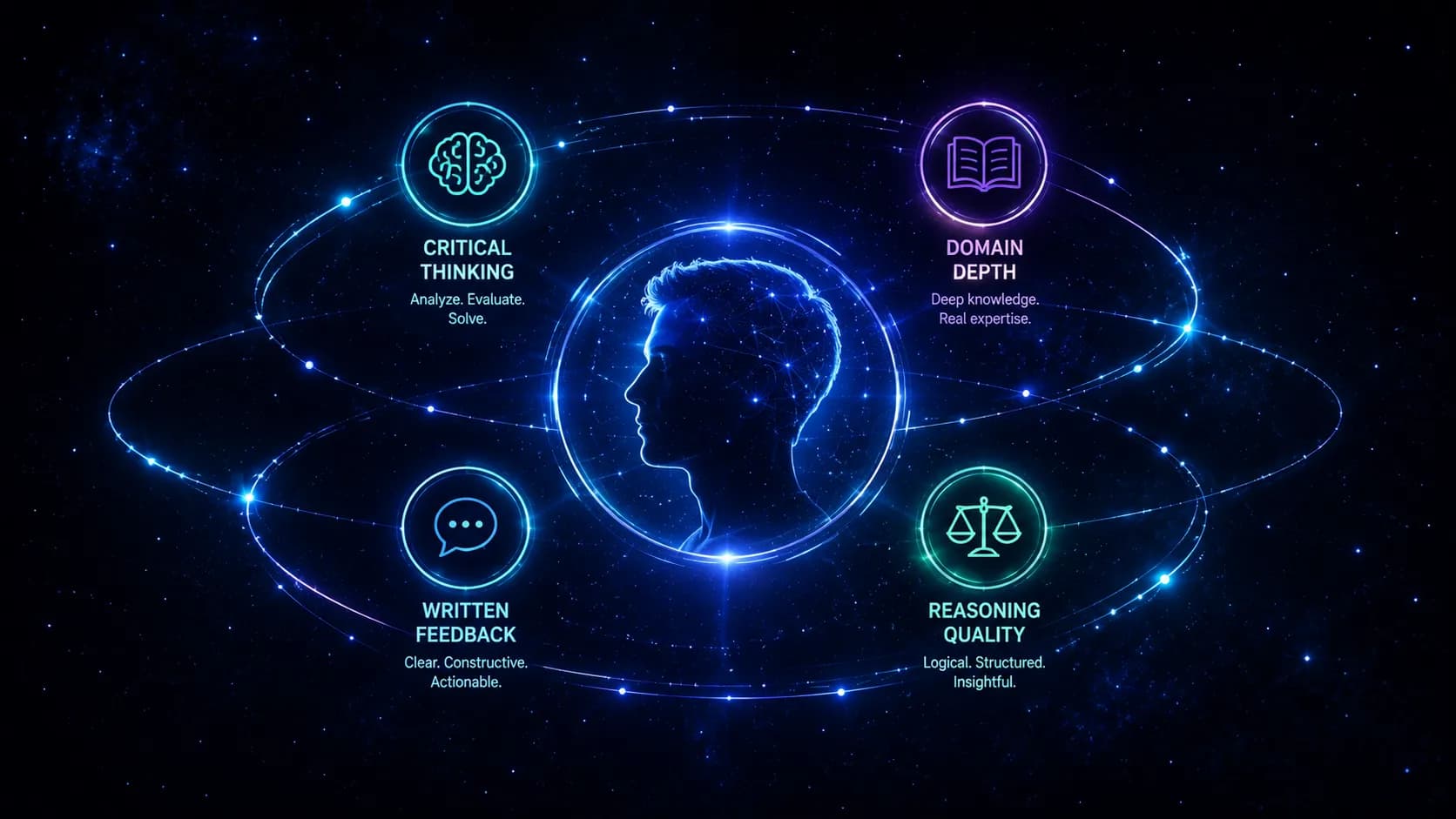
The skills that get you hired for generative AI training roles are not the ones the job boards advertise. Platforms do not test "AI literacy" or "machine learning knowledge" first. They test instruction-following, written precision, and judgment consistency, and they rank domain knowledge behind those. This guide lists the skill stack in the order assessments actually weigh it, so you can point every hour of preparation at the thing that raises your score.
The skill stack, ranked by what assessments measure#
| Rank | Skill | Why it matters | How it is tested |
|---|---|---|---|
| 1 | Instruction-following | The entire job is applying rubrics exactly | Written assessment with multi-part instructions |
| 2 | Written precision | Justifications are the product | Writing tasks graded on clarity and grammar |
| 3 | Judgment consistency | Scores must match across 100 similar tasks | Batch tasks with hidden control items |
| 4 | Domain knowledge | Sets the track and the rate band | Domain assessment for expert tracks |
| 5 | Reasoning under ambiguity | Many outputs have no single right answer | Edge-case tasks without clear cues |
| 6 | Tooling comfort | Browser dashboards, text editors, spreadsheets | Realistic task environment |
Notice what is missing: no "generative AI experience" requirement at the top of the list. That is not an oversight. The platforms that structure these roles have learned that rubric reliability predicts performance better than claimed experience, which is why generalist tracks accept applicants with none. The evaluator day-to-day guide shows how the rubric reliability shows up in the work itself.
What each assessment actually measures#
The generalist assessment: writing under a rubric
Generalist assessments look like short writing tasks with precise constraints: "In 3–5 sentences, explain X. Use plain language. Do not use the words in list A. Address both sides of argument B." The test measures whether you can follow constraints while writing cleanly. Most failures come from ignoring one constraint, not from weak writing.
The coding assessment: correctness under specification
Coding tracks test review, not just generation. You read a specification, review generated code against it, and explain your verdict. The skills tested are specification reading, logic checking, and written justification, in that order. The pay guide notes that passing coders move straight into the $50–$60+ band.
The expert assessment: domain judgment with evidence
Expert tracks test whether your domain judgment holds under model-generated noise: fabricated citations, plausible-but-wrong math, confidently incorrect medicine. The assessment measures how quickly you catch the error and how clearly you explain it. Credentials open the door, but the assessment decides the rate tier.
The skills that look impressive but do not matter#
- "AI experience" as a claim. Platforms discount unsupported claims. The assessment is the proof, and prior AI work without rubric reliability does not carry weight.
- Broad tool lists. Knowing every framework names nothing. One named, provable skill beats a cloud of twelve.
- Crypto or side-hustle fluency. It does not appear in any assessment rubric we have structured roles for.
- Certificates from unverifiable courses. Platforms verify what they pay for, and third-party course certificates are not part of the verification chain.
From structuring generative AI training roles on NearSkill: the candidates who advance fastest are rarely the most technically credentialed. They are the ones who treat the guidelines as law, write justifications that cite the response directly, and never submit a batch without re-reading the rubric. Every one of those is trainable in a week of deliberate practice.
How to train the top-three skills in a week#
- Day 1–2: Instruction-following. Take any published evaluation rubric (platforms publish samples) and grade 20 model outputs against it. For each score, write a two-sentence justification.
- Day 3–4: Written precision. Rewrite each justification to under 40 words with no filler. Then cut every adverb. Compare drafts; the second pass is the skill.
- Day 5: Judgment consistency. Re-grade the first 10 outputs without looking at your scores. Count disagreements. Disagreement under 10% means ready; over 20% means the rubric is not internalized yet.
- Day 6–7: Domain verification. If you are targeting an expert track, run the same drill on domain-specific outputs and check every factual claim the model makes.
The drill matters more than the content. Platforms re-test the same underlying skills every quarter, and the practice stays useful. Pair it with a resume that names your real skills exactly, covered in the resume guide.
What assessment questions look like, by track#
The fastest way to prepare is to see the shape of the questions before you take them. Representative examples from each track:
| Track | What the task looks like | What it measures |
|---|---|---|
| Generalist | Rewrite this response so a 12-year-old understands it, in under 60 words, without using the listed terms | Instruction-following + writing precision |
| Coding | The generated function below misses an edge case. Find it, explain it, and score the fix | Specification reading + logic |
| STEM | This solution claims a result. Verify the derivation step by step and identify where it breaks | Domain judgment + evidence |
| Expert professional | The model cites a regulation that does not exist. Respond as you would in review | Fabrication detection + domain accuracy |
Every task shares one structure: a constraint set, an output to judge, and a written justification. Preparing for the structure beats preparing for the topic, because the topic is a surprise and the structure never is.
The 80/20 of preparation#
If you have limited time before an assessment, spend it in this order, and skip what is below the line:
- 80%: Write justifications, then tighten them. Fifty short justifications, each under 40 words, each citing the response directly. This single drill raises every assessment score.
- 15%: Re-read the platform’s sample rubric until you can score from memory. The rubric definitions are the answer key.
- 5%: Practice the batch rhythm. Three sessions of 30 tasks with a 5-minute break between, to simulate real pace.
Below the line: memorizing AI terminology, watching tutorials on "prompt engineering", and buying certification courses. None of these appear in assessment rubrics, and none of them move your score. The resume guide shows how to frame the same preparation as experience once you have it.
How the skills map to role types#
The same skill stack weights differently across role types, and matching your strongest skills to the right role type is the quietest way to raise your chances:
| Role type | Heaviest skills | Lightest skills |
|---|---|---|
| Generalist trainer | Instruction-following, writing | Domain depth, tooling |
| Coding evaluator | Spec reading, logic review | Creative writing, marketing-adjacent skills |
| Domain expert | Credential, fabrication detection | Generalist speed |
| Red-teamer | Adversarial reasoning, current knowledge | Formatting and volume |
| Language specialist | Native fluency, cultural nuance | Coding and statistics |
The mismatch pattern is the common failure: a strong writer applying to a coding track, or an expert applying to a generalist queue. Both fail assessments that their skills would have passed in the right track. The pay guide lists which tracks pay what, so the role-type choice has a rate attached to it.
Keeping skills current in a fast-moving field#
Generative AI changes the tools and the models faster than it changes the underlying skills. The three top skills, instruction-following, writing, and consistency, stay constant; what moves is the subject matter you evaluate and the rubric language platforms use. Three habits keep your skill stack current without a course budget:
- Re-read guidelines monthly. Rubric definitions shift as model behavior changes, and the newest definition is the one being scored.
- Run a monthly calibration batch. Re-score twenty old tasks against the new guidelines and compare with the platform scores. Disagreement above 10% means drift.
- Follow what new tracks ask for. Each new model family brings new track types and new assessment shapes. The platform rate guides track which tracks are opening and what they require.
The pattern holds across every platform we structure roles for: the evaluators who keep top project access are the ones who treat calibration as a monthly habit, not a quarterly reaction. The skill is maintenance, and maintenance is a skill.
The bottom line#
The skills for generative AI training roles that matter, in order: instruction-following, written precision, and judgment consistency. Domain knowledge sets your track and rate, and tooling comfort is table stakes. The good news: all three top skills are trainable in a week of deliberate practice, and none of them require prior AI experience to start.
Next step: browse live AI training roles with published requirements, or upload your resume to see which tracks score highest against your current skills.
See which AI training tracks match your skills
Upload your resume and get every live generative AI training and evaluation role ranked by fit score. Free, no account.
Written for real AI training and domain expert candidates. No fluff, no recycled job board advice.
Frequently asked questions
What skills do I need to start in generative AI training?
Strong written English, careful reading, and the ability to follow a rubric exactly. No machine learning knowledge is required for generalist tracks. Coding and STEM tracks add a technical assessment, and expert tracks add verifiable domain credentials.
Do I need to know prompt engineering?
Not to start. Prompt craft is taught in project onboarding, and it develops through the work itself. What assessments measure first is whether you can follow instructions and judge outputs against criteria. Prompt fluency becomes an advantage at the expert tier.
Which skill predicts success best?
Instruction-following consistency. Evaluators who apply a rubric identically across hundreds of tasks keep high quality scores and get first access to new projects. Everything else, including domain knowledge, sits behind that reliability.
How do I prove my skills without prior AI experience?
Show the same abilities in another uniform: teaching shows explanation and assessment, editing shows written precision, QA shows spec-following. Frame each with numbers, then let the platform assessment verify. The resume guide shows the exact framing.

Ankit Kumar
Founder, NearSkill
Ankit Kumar is the founder of NearSkill, an AI-powered career matching engine for specialized tech and AI roles, including generative AI training, domain expert evaluation, data science, and advanced software engineering. He built NearSkill after watching the specialized AI job market fragment into postings with missing pay, inconsistent skill requirements, and no way to compare roles side by side. His guides cover AI trainer and domain expert compensation, resume strategy for evaluation roles, how fit scores work, and the skills that matter in generative AI training work.
Related guides

How to Write a Resume That Works for AI Training and Domain Expert Roles
AI evaluation jobs screen for precision, domain depth, and clear writing. A resume that proves those three beats a longer one that only lists duties.

What Do AI Evaluators and Domain Experts Actually Do Day to Day?
AI evaluation is a loop: read the task, judge the output, justify the score in writing. Here is the real day-to-day and what gets people dropped from projects.

Highest-Paying Domain Expertise for AI Training Work in 2026
Regulated and high-stakes domains pay $50–$200/hr for AI evaluation work. Here is the ranking, the proof requirements, and where competition is thinnest.
Find the roles that actually fit you
Upload your resume and get every live role ranked by fit score, with pay ranges attached. Free, no account, results in seconds.